Walking through a historic district can tell you things that a museum display sometimes cannot.
A temple might stand beside an old merchant house, a colonial building may face a traditional market, and the food sold nearby could carry influences from communities that arrived hundreds of years apart.
That is what makes heritage trails across Asia so interesting. They do not simply connect old buildings. They reveal how generations of migration, religion, trade, empire, conflict, and everyday life have accumulated in the same landscape.
Asia’s cultural identity has never been completely fixed. From the Silk Roads of Central Asia to pilgrimage paths in Japan and trading ports in Southeast Asia, people constantly exchanged ideas and adapted foreign influences to local traditions.
Following these historic routes helps travelers see those connections at street level. Instead of treating history as a collection of seperate periods, heritage trails show how the past overlaps—and how those layers continue shaping communities today.
Heritage Trails Turn History Into a Physical Journey
A heritage trail is essentially a route connecting places with historical, cultural, architectural, or spiritual significance. Some are carefully designed urban walking routes, while others follow ancient pilgrimage paths, trading corridors, or roads once used by merchants.
Their real value comes from context.
Seeing an individual shrine or old house tells one story. Walking between several sites reveals relationships between them.
Travelers begin noticing where communities settled, how streets developed, which buildings occupied powerful locations, and how different religious traditions existed close together.
This makes heritage walking unusually effective for understanding cultural identity.
A city may have changed rulers five times, welcomed several migrant groups, and adopted architectural influences from distant countries. Those changes can remain visible in street layouts, sacred buildings, shopfronts, languages, festivals, and food.
Heritage trails connect those pieces into one readable landscape.
The Silk Roads Show That Asian Cultures Were Never Isolated
Few examples illustrate layered identity better than the Silk Roads.
Rather than one continuous road, the Silk Roads formed a massive network connecting societies across East Asia, Central Asia, South Asia, Western Asia, and beyond.
UNESCO describes them as land and maritime routes that transported not only merchandise but also knowledge, technologies, religions, languages, and artistic ideas.
The UNESCO-listed Chang’an–Tianshan Corridor stretches roughly 5,000 kilometres between central China and Central Asia.
Its 33 components include ancient cities, trading settlements, Buddhist cave temples, passes, fortifications, posthouses, and sections of the Great Wall.
Imagine following sections of that corridor today.
A traveler is not simply looking at abandoned roads. The landscape reveals how merchants, soldiers, monks, diplomats, and migrants interacted over centuries.
Buddhist art found in Central Asian or Chinese sites, for example, often reflects influences arriving through long-distance cultural exchange.
The route itself becomes evidence that cultural identity develops through contact rather than isolation.
Japan’s Pilgrimage Routes Reveal Layers of Spiritual Identity
Heritage trails do not always grow from commerce. Some developed because people were searching for spiritual meaning.
Japan’s Sacred Sites and Pilgrimage Routes in the Kii Mountain Range provide a powerful example. The UNESCO World Heritage property connects Yoshino and Omine, Kumano Sanzan, and Koyasan through historic pilgrimage paths.
These routes reflect more than 1,200 years of sacred mountain traditions and demonstrate interaction between Shinto nature worship, Buddhism introduced from mainland Asia, and the distinctive Japanese tradition of Shugendo. UNESCO identifies around 307 kilometres of pilgrimage routes within the cultural landscape.
That mixture is exactly what layered cultural identity looks like.
Instead of one belief replacing another, religious traditions influenced each other. Sacred forests, waterfalls, temples, shrines, and mountain paths became part of an interconnected spiritual landscape.
Walking these trails today can therefore reveal something that reading dates alone may miss: beliefs evolve through coexistence, adaptation, and reinterpretation.
Melaka and George Town Tell the Story of Migration and Trade
Urban heritage trails can show cultural layering even more clearly because multiple communities often occupied the same compact area.
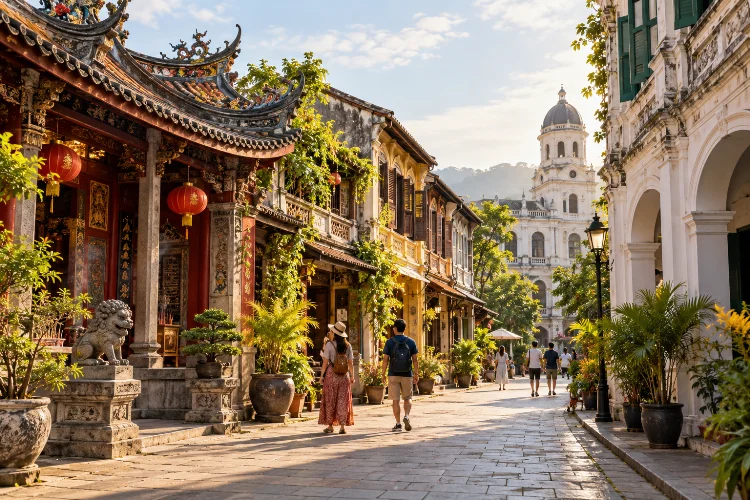
Melaka and George Town in Malaysia developed through centuries of trade across the Strait of Malacca. Their historic districts contain influences associated with Malay, Chinese, Indian, and European communities.
UNESCO describes the two cities as products of more than 500 years of trading and cultural exchanges between East and West. Melaka reflects layers including the Malay sultanate and Portuguese and Dutch periods, while George Town strongly represents the later British era.
Yet architecture is only part of the story.
Historic religious buildings, languages, festivals, cuisine, shop houses, neighbourhoods, and trading traditions all demonstrate how different communities lived alongside one another.
Walk through such districts and cultural identity stops looking like a simple label. It becomes a combination of memories created by generations of merchants, migrants, administrators, religious communities, and local families.
Even something as everyday as breakfast can contain centuries of migration history.
Hoi An Shows How Foreign Influence Becomes Local Heritage
Vietnam’s Hoi An provides another fascinating example.
Between the 15th and 19th centuries, Hoi An developed as an important Southeast Asian trading port. Merchants from different parts of Asia and later Europe interacted with the local population, leaving traces in architecture, commerce, religious traditions, and urban design.
UNESCO describes Hoi An as an exceptionally well-preserved trading port whose buildings and street plan combine indigenous traditions with Chinese, Japanese, and later European influences.
Walking through Hoi An therefore feels less like visiting one historical period and more like moving through several simultaneously.
Merchant houses, assembly halls, temples, narrow streets, waterfront spaces, and traditional businesses demonstrate how outside influences were absorbed rather than simply copied.
Over time, what once arrived from somewhere else became part of local identity.
That process appears repeatedly across Asia: cultural exchange creates something new rather than producing perfect replicas of foreign traditions.
Kathmandu Reveals Religious Traditions Living Side by Side
Heritage routes through Nepal’s Kathmandu Valley reveal another type of layering – religious and artistic traditions existing within the same cultural landscape.
The UNESCO World Heritage property contains seven monument zones, including the Durbar Squares of Kathmandu, Patan, and Bhaktapur, Buddhist stupas such as Swayambhu and Bauddhanath, and important Hindu sites including Pashupati and Changu Narayan.
Travel between these locations and the distinction between “Buddhist heritage” and “Hindu heritage” can become less rigid than expected.
Architectural styles, rituals, craftsmanship, public spaces, and religious symbolism have developed through long interaction between communities.
The streets between major monuments matter as much as the landmarks themselves. Courtyards, workshops, markets, smaller shrines, and local homes reveal how heritage survives within everyday life.
That living enviroment gives cultural identity depth that isolated monuments cannot provide.
Heritage Is Also Found Between the Famous Landmarks
One common mistake when exploring heritage destinations is moving quickly from one major attraction to another.
Doing that can mean missing the most revealing cultural details.
The route between landmarks may include traditional workshops, historic water systems, old cemeteries, community shrines, vernacular houses, street-food traditions, or neighbourhood layouts shaped by former ethnic communities.
These smaller elements often explain how ordinary people experienced historical change.
A grand palace tells us about rulers. A merchant street explains commerce. A shrine reveals belief. A row of traditional houses may show how family structures, climate, materials, and social status shaped everyday architecture.
Together, they create a much richer picture.
The strongest heritage trails therefore encourage travelers to observe relationships rather than simply collect famous sights.
Living Traditions Make Heritage Trails More Meaningful
Cultural identity is not stored only in stone.
Festivals, cooking techniques, religious ceremonies, craft traditions, oral stories, music, and languages can be just as important as historical buildings.
This is why some heritage districts feel genuinely alive while others risk becoming decorative tourist zones.
In Melaka or George Town, for example, multicultural heritage is still visible in religious practice, cuisine, celebrations, architecture, and daily life – not merely in preserved monuments. UNESCO specifically recognizes both tangible and intangible elements within their historic identity.
Travelers can experience heritage more deeply by paying attention to those traditons.
Instead of photographing a historic market and immediately leaving, observe what is sold there. Ask why certain foods are associated with specific communities. Look at religious calendars, craft workshops, and the languages appearing around neighborhoods.
Those details often reveal cultural connections that guidebooks barely mention.
How to Explore Heritage Trails More Thoughtfully
The best way to explore a heritage trail is slowly.
Before arriving, learn a little about the groups that shaped the area. Knowing whether a neighborhood was influenced by merchants, pilgrims, colonial administrators, artisans, or migrant communities makes architectural details easier to understand.
Once there, avoid focusing only on designated monuments.
Look at street patterns, building materials, religious diversity, old transportation routes, markets, food, and public spaces. Comparing these elements can reveal which historical layers belong to different periods.
It is also worth remembering that heritage districts are often real communities rather than outdoor museums.
Respecting religious practices, supporting local businesses, following preservation rules, and avoiding disruptive behavior helps ensure heritage tourism benefits the people who continue maintaining these places.
Heritage trails across Asia reveal that cultural identity is rarely created by a single civilization, religion, or historical moment. It develops through centuries of trade, migration, pilgrimage, political change, cultural exchange, and ordinary community life.
From the Silk Roads and Japan’s sacred mountain paths to Hoi An, Kathmandu, Melaka, and George Town, historic routes allow travelers to see those layers physically connected within the landscape.
That is what makes heritage walking so rewarding. You are not simply moving between old buildings – you are tracing how people, ideas, and traditions transformed one another.
Next time you visit a historic Asian destination, explore beyond its most famous landmark. Follow the older streets, notice the communities around them, and treat the entire journey as part of the historical story.