Ancient Asia was far more connected than it might appear on a modern map.
Thousands of years before airplanes, container ships, and digital marketplaces, merchants were already moving silk, spices, precious stones, ceramics, horses, metals, and countless other goods across enormous distances.
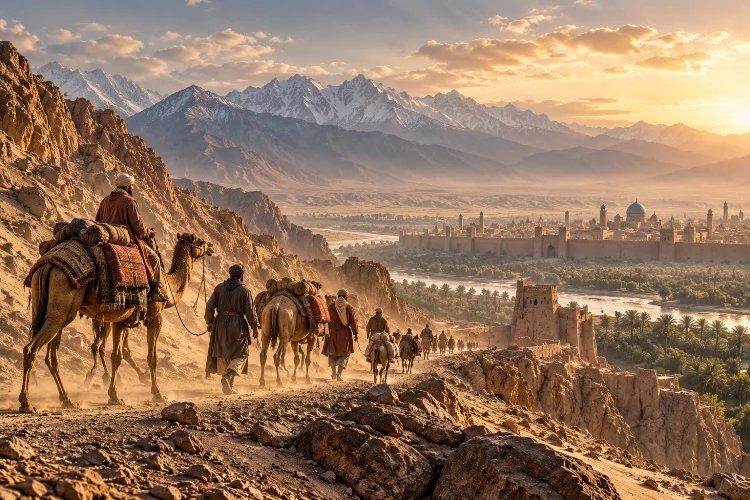
These journeys followed a complex web of ancient trade routes across Asia, linking China with Central Asia, India, Persia, Southeast Asia, and eventually the Mediterranean world.
Some routes crossed deserts and mountain passes, while others depended on monsoon winds and busy maritime ports.
The famous Silk Road was only one part of this system. Caravan towns, oasis settlements, imperial highways, and sea lanes all helped create a surprisingly interconnected commercial world.
More importantly, trade moved much more than merchandise. Religions, languages, technologies, artistic styles, foods, and scientific ideas travelled alongside merchants.
Exploring these routes therefore offers a fascinating way to understand how many of Asia’s historic regions developed – and why cultures separated by thousands of kilometres often share unexpected connections.
The Silk Road Was a Network, Not a Single Road
The phrase “Silk Road” can create the impression of one enormous highway running directly from China to Europe. In reality, it was a shifting network of roads, caravan trails, mountain passages, and regional trading hubs.
UNESCO describes the Silk Roads as interconnected land and maritime routes that carried goods, knowledge, beliefs, and cultures across Eurasia.
One UNESCO-listed section, the Chang’an–Tianshan Corridor, alone stretches roughly 5,000 kilometres between central China and Central Asia.
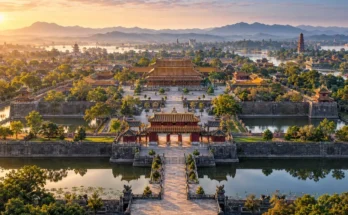
Chang’an, modern Xi’an, became an important eastern gateway. From there, routes moved through the Hexi Corridor toward Dunhuang before separating into paths around the dangerous Taklamakan Desert.
Few merchants actually travelled from China all the way to the Mediterranean. Goods usually changed hands repeatedly. A bolt of silk might pass through several seperate merchant communities before reaching Persia or the Roman world.
That relay system made intermediary cities incredibly important.
Central Asia Became the Crossroads of Eurasian Commerce
Regions that today include Uzbekistan, Kazakhstan, Kyrgyzstan, Tajikistan, and parts of Afghanistan were not merely empty spaces between larger civilizations. They were central to the entire trading system.
Cities such as Samarkand and Bukhara grew around strategic oasis locations where merchants could rest animals, buy supplies, exchange currencies, and negotiate deals.
Among the most influential trading communities were the Sogdians. Their homeland lay around parts of modern Uzbekistan and Tajikistan, but Sogdian merchants developed commercial networks stretching across much of Eurasia.
The Smithsonian’s National Museum of Asian Art notes that Sogdian merchants became particularly influential on routes connecting areas from the Mediterranean toward East Asia. Their oasis cities offered crucial stopping points between deserts and mountain ranges.
These traders demonstrate an important feature of ancient commerce: geography often mattered more than political borders.
Control the oasis, mountain pass, river crossing, or caravan station, and you could influence enormous flows of international trade.
China Supplied Much More Than Silk
Silk became the product most strongly associated with Asian overland trade, but merchants carried a much wider range of goods.
Chinese silk, ceramics, lacquerware, and manufactured objects moved westward. In return, traders brought horses, glassware, precious metals, gemstones, grapes, textiles, and other foreign products east.
During the Han dynasty, especially under Emperor Wu in the second century BCE, Chinese political and military expansion increased contact with Central Asian regions.
The Smithsonian notes that control of routes toward Central Asia helped strengthen trade connections extending toward the Near East and Mediterranean.
Those connections became even more visible during the Tang dynasty from 618 to 907 CE. Tang China developed highly cosmopolitan cities where foreign merchants, diplomats, religious travellers, and craftsmen could be found.
Chang’an was not simply an imperial capital. It functioned almost like an early global city.
Persia Linked Eastern and Western Markets
Moving farther west brings us into the Iranian Plateau, another critical zone in ancient Eurasian commerce.
Persian empires controlled territories positioned between Central Asia, Mesopotamia, India, and the Mediterranean. Long before the Silk Road reached its most famous period, Persian imperial highways already supported communication and trade across vast distances.
UNESCO notes that the Achaemenid Persian Royal Road formed part of the broader geographical framework that later connected with the Silk Roads.
Centuries later, cities such as Nishapur flourished as important commercial centres. Located in present-day Iran, Nishapur sat along routes connecting China and Central Asia with western regions.
The Metropolitan Museum of Art describes the medieval city as both a major regional capital and an economic centre producing goods such as cotton textiles while participating in long-distance Silk Road commerce.
Rather than simply passing through Persia, merhcants exchanged products, techniques, beliefs, and artistic influences there.
India Connected Overland Routes With the Indian Ocean
South Asia occupied an exceptional position because it connected both continental and maritime trading networks.
Northern routes crossed regions leading toward Afghanistan and Central Asia, while western ports connected India with Arabia and East Africa. Eastern maritime connections extended toward Sri Lanka, Southeast Asia, and eventually China.
Indian merchants exported spices, textiles, gemstones, ivory, aromatics, and other high-value products. Ports along the western and southern coasts benefited from seasonal monsoon winds, which made long-distance sailing more predictable.
Sailors gradually learned that winds changed direction according to the season. This allowed vessels to cross the Arabian Sea and return months later rather than hugging coastlines for an entire journey.
The result was a maritime commercial system that complemented the famous land routes.
Southeast Asia Controlled Strategic Maritime Gateways
Southeast Asia became especially important because ships travelling between the Indian Ocean and the South China Sea had to navigate a limited number of practical maritime corridors.
The Strait of Malacca eventually became one of the most famous examples.
Merchants travelling between India, China, and island Southeast Asia passed through ports where spices, forest products, ceramics, textiles, metals, and luxury goods could be exchanged.
The Smithsonian describes the Indian Ocean trade network as connecting Southeast Asia, India, Arabia, and East Africa, showing how Asian maritime commerce formed part of a much larger system.
Port settlements were therefore more than warehouses beside the sea. They became multicultural meeting places where sailors and traders encountered unfamiliar languages, religions, foods, and customs.
In that enviroment, cultural mixing was almost unavoidable.
Trade Routes Also Carried Religions and Ideas
Perhaps the most important cargo transported along ancient routes could not be weighed.
Buddhism provides a powerful example. Originating in South Asia, Buddhist teachings travelled through Central Asia into China, supported partly by the same roads used by merchants.
Religious communities often developed near trading cities and caravan stops. Travellers could find accommodation, food, information, and contacts while religious institutions gained exposure to people arriving from distant regions.
Christianity, Zoroastrianism, Manichaeism, Islam, and other belief systems also travelled through commercial networks at different periods.
UNESCO emphasizes that merchants helped spread not only commodities but knowledge, religious beliefs, technology, and cultural practices across Eurasia.
The same process affected art and technology. Textile patterns crossed borders. Glassmaking techniques travelled. Musical instruments appeared far from their original regions. Even crops and cooking traditions changed as plants and ingredients moved between markets.
Ancient globalization was slower than today’s version, but it was realy powerful.
Why These Ancient Trade Routes Still Matter
Looking at ancient Asian trade changes the way we understand history.
Civilizations were rarely isolated worlds developing independently. China influenced Central Asia, Persia interacted with India, Southeast Asian ports linked distant seas, and merchants acted as unofficial cultural ambassadors.
UNESCO’s research on the Silk Roads highlights how these networks connected communities over enormous distances and encouraged exchanges in science, religion, technology, culture, and commerce.
Many modern cities also owe part of their importance to geography established centuries earlier.
Historic trading centres often emerged near navigable rivers, sheltered harbours, fertile oases, or narrow transportation corridors—the same strategic principles that influence logistics today.
Following old trade routes can therefore reveal why particular cities rose, why empires competed over certain territories, and why cultural similarities appear in places separated by thousands of kilometres.
Exploring ancient trade routes across Asia reveals a continent connected by movement long before modern globalization.
The Silk Road caravans, Persian highways, Central Asian oasis cities, Indian Ocean shipping lanes, and Southeast Asian ports formed parts of one enormous and constantly changing exchange system.
Merchants transported silk, spices, horses, ceramics, gemstones, and textiles, but their influence went much further. Languages, religions, technologies, foods, artistic ideas, and knowledge travelled with them.
Understanding these historic networks makes Asia’s past feel less like a collection of isolated civilizations and more like an interconnected world.
If you enjoy cultural history, start exploring individual stops such as Xi’an, Dunhuang, Samarkand, Bukhara, Nishapur, and historic Indian Ocean ports. Each destination reveals another chapter in the story of how trade helped shape Asia.