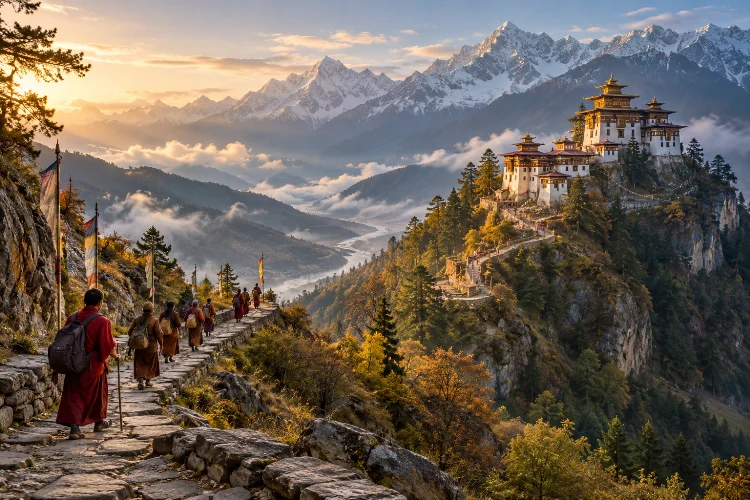
Long before travelers crossed Asia for leisure, millions of journeys were motivated by something much more personal: faith.
Pilgrims walked through forests, crossed mountains, followed rivers, and traveled between cities to reach temples, monasteries, stupas, shrines, and other sacred places.
Those journeys gradually created some of Asia’s most important historic travel networks.
Understanding how sacred architecture shapes historic travel routes in Asia means looking beyond individual monuments.
A temple could become the destination of a pilgrimage, but it could also encourage roads, accommodation, markets, bridges, religious communities, and smaller shrines to develop around the journey.
Over centuries, these routes connected spiritual centres with capitals, trading towns, rural settlements, and distant regions. Buddhism, Hinduism, Shinto traditions, and other belief systems moved through many of the same landscapes used by merchants and political travelers.
Today, following these historic corridors offers something unusual. Travelers can experience architecture not as isolated buildings, but as markers within much larger cultural landscapes shaped by movement, belief, and memory.
Sacred Buildings Could Turn Remote Places Into Destinations
Sacred architecture often emerged in locations that were not necessarily convenient.
Mountaintops, forests, caves, riverbanks, and isolated valleys could become holy because of religious events, natural features, sacred legends, or associations with important spiritual figures. Once a temple or shrine became significant, people needed ways to reach it.
Travel routes followed.
Paths were improved, bridges were constructed, rest points appeared, and communities grew around the movement of pilgrims. Over generations, an isolated religious site could become the centre of a regional travel system.
This relationship between destination and route is important.
Historic travelers were not simply moving through landscapes randomly. Sacred architecture gave many journeys a clear direction, transforming certain roads into culturally meaningful paths.
Japan’s Kii Mountains Show Architecture and Pilgrimage Working Together
One of the clearest examples can be found in Japan’s Kii Mountain Range.
The sacred sites of Yoshino and Omine, Kumano Sanzan, and Koyasan are connected by historic pilgrimage trails running through mountainous forest landscapes.
These routes also linked the sacred areas with the ancient capitals of Nara and Kyoto. UNESCO records approximately 307 kilometres of pilgrimage routes within the World Heritage property.
The landscape reflects more than 1,200 years of religious tradition.
Shinto nature worship interacted with Buddhism and Shugendo, creating a religious culture in which the mountains themselves became part of spiritual practice. Shrines and temples were therefore not separate from the landscape around them.
Walking was part of the experience.
Travel through steep forests, rivers, and mountain passes prepared pilgrims physically and spiritually before they reached important sacred buildings.
That relationship helps explain why pilgrimage architecture cannot always be understood without the route leading toward it.
Bodh Gaya Became a Destination Because of Sacred Memory
Sometimes a travel route develops because one location becomes associated with a defining religious event.
Bodh Gaya in eastern India is one of the strongest examples.
The Mahabodhi Temple Complex marks the location traditionally associated with the Buddha’s attainment of enlightenment.
According to UNESCO, Emperor Ashoka constructed the first temple there in the third century BCE, while the surviving main temple largely dates to the fifth or sixth centuries.
Its significance turned Bodh Gaya into one of Buddhism’s major pilgrimage destinations.
Travelers from different Buddhist regions have visited the site for centuries, meaning that a single sacred landscape helped create connections between South Asia and communities much farther away.
Architecture became a physical anchor for religious memory.
Instead of enlightenment surviving only as a story, the temple gave pilgrims a specific location to reach, experience, and remember.
That is one of the most powerful ways sacred buildings influence human movement.
Lumbini Shows How Pilgrimage Routes Grow Around Sacred Geography
Nepal’s Lumbini offers a similar example.
Traditionally identified as the birthplace of Siddhartha Gautama, Lumbini became an important Buddhist pilgrimage destination at a remarkably early period. UNESCO records that Emperor Ashoka visited the site and erected a commemorative pillar there in 249 BCE.
The archaeological landscape contains monasteries, stupas, the Maya Devi Temple, and the Ashoka Pillar.
These structures reveal how sacred architecture accumulated over many centuries. One generation did not create the whole religious landscape at once.
Instead, pilgrims, rulers, monasteries, and communities repeatedly added new elements.
This gradual development matters because historic pilgrimage routes often worked the same way. A major shrine attracted travelers, smaller religious sites appeared around it, services developed for visitors, and the wider region became associated with sacred travel.
A spiritual destination could therefore influence an entire travel geography.
Borobudur Connects Architecture, Ritual, and Movement
Borobudur in Central Java demonstrates how movement can be built directly into sacred architecture.
Constructed during the eighth and ninth centuries under the Syailendra Dynasty, Borobudur consists of ascending terraces topped by circular platforms and a monumental stupa.
The complex also includes the nearby Mendut and Pawon temples, positioned along an approximate east-west alignment.
Visitors do not simply stand outside Borobudur and observe it.
The monument encourages physical movement through its architectural levels. Its terraces, reliefs, stupas, and upward progression transform movement into part of the spiritual experience.
In this sense, architecture creates a journey within the destination itself.
The wider temple landscape adds another layer. Borobudur, Pawon, and Mendut can be understood not merely as seperate monuments but as related sacred places within a broader cultural setting.
This makes Central Java an excellent example of how religious architecture can organize movement at both monumental and regional scales.
Kathmandu Shows How Multiple Sacred Sites Create Urban Routes
Sacred travel does not always involve crossing hundreds of kilometres.
Sometimes religious architecture creates networks inside a city or valley.
The Kathmandu Valley contains important Buddhist and Hindu sites alongside historic royal centres.
UNESCO’s World Heritage property includes Swayambhu and Bauddhanath stupas, Pashupati and Changu Narayan temples, and the Durbar Squares of Kathmandu, Patan, and Bhaktapur.
Together, they create a landscape where political and religious history constantly overlap.
Travel between the monuments reveals different communities, architectural traditions, neighbourhoods, markets, and devotional practices.
This is especially valuable for heritage travelers.
Instead of treating Kathmandu’s temples as isolated attractions, following connections between sacred places can reveal how religion influenced the wider urban landscape.
The journey between monuments becomes part of the historical experience.
Kandy Shows How Sacred Architecture Can Define a Royal City
Sri Lanka’s Kandy demonstrates another pattern: sacred architecture becoming closely tied to royal authority.
Kandy was the final capital of the Sinhala kings before British occupation in 1815. It is also home to the Temple of the Tooth Relic, one of Buddhism’s important pilgrimage destinations.
The presence of the relic gave the city enormous religious significance.
Royal power and sacred legitimacy became deeply connected, encouraging pilgrims to travel toward a place that functioned simultaneously as political capital and spiritual centre.
This pattern appears elsewhere across Asia.
Rulers frequently supported temples, monasteries, and religious monuments because sacred patronage could strengthen political legitimacy. Pilgrimage traffic, meanwhile, brought people from outside the capital and encouraged commercial activity around major religious institutions.
Religion, politics, and travel were often much more interconnected than modern categories suggest.
Kyoto Demonstrates How Religious Networks Survive Political Change
Some sacred travel networks continue long after a city loses its original political role.
Kyoto served as Japan’s imperial capital from 794 until the middle of the nineteenth century. Over more than a millennium, the city became a major centre for temples, shrines, gardens, architecture, religious scholarship, and artistic traditions.
Its political status eventually changed, but its religious geography remained enormously influential.
Historic temples and shrines still structure the way many visitors experience Kyoto today. Moving between sacred compounds effectively follows patterns created by centuries of religious patronage and cultural development.
This shows how old travel routes can acquire new purposes.
A path once followed by monks, aristocrats, or pilgrims may later become part of a heritage itinerary. The travelers change, but the architecture continues directing movement.
Sacred Routes Also Created Markets and Communities
Pilgrimage was spiritual, but pilgrims still needed food, shelter, transportation, and supplies.
That simple reality had economic consequences.
Guesthouses could appear near sacred destinations. Markets developed around temples. Artisans produced devotional objects, clothing, ceramics, food, and gifts. Transport services evolved to help visitors complete difficult sections of their journeys.
Over time, some temple approaches became thriving commercial streets.
This does not make pilgrimage less religious. Instead, it shows that sacred movement influenced everyday economic life.
Historic roads linking temples and cities could also overlap with trading networks. Merchants, pilgrims, monks, diplomats, and ordinary travelers frequently used similar infrastructure.
That overlap helped ideas circulate.
Religious texts, artistic styles, architectural knowledge, rituals, and technologies could travel along the same corridors as commercial goods.
How to Explore Sacred Travel Routes More Meaningfully
Modern visitors often arrive at famous temples by bus, train, or taxi, which can make the historic journey almost invisible.
A more rewarding approach is to study the old route before visiting.
Look for historic gates, temple roads, pilgrimage markers, river crossings, smaller shrines, monasteries, traditional accomodation, and settlements that once supported travelers.
Pay attention to geography as well.
Ask why a shrine faces a particular mountain, why a monastery developed beside a river, or why a temple sits at the end of a difficult forest trail.
And remember that many sacred sites remain active places of worship.
Travel respectfully, follow local rules, avoid interrupting ceremonies, and treat religious buildings as living cultural spaces rather than simply photogenic historical objects.
Understanding how sacred architecture shapes historic travel routes in Asia reveals a deeper relationship between buildings and movement.
Temples, stupas, monasteries, and shrines did not simply wait for travelers to arrive; their spiritual significance helped determine where people traveled and how surrounding landscapes developed.
From the pilgrimage paths of Japan’s Kii Mountains to Bodh Gaya, Lumbini, Borobudur, Kathmandu, Kandy, and Kyoto, sacred destinations connected religion with roads, cities, commerce, politics, and cultural exchange.
For modern travelers, these routes offer a richer way to experience Asian heritage.
Instead of visiting one monument and leaving, trace the paths between sacred places, observe the communities that grew around them, and explore how centuries of movement transformed both architecture and landscape.