The Himalayas never really have one trekking season. A route that feels perfect in October may be buried under snow in January, soaked by monsoon rain in July, or covered with flowering rhododendrons in April.
That is why designing seasonal trekking routes across the Asian Himalayas requires more than choosing a famous trail and booking flights during the cheapest month.
Elevation, precipitation, snow conditions, daylight, road access, and even the direction mountains face can completely change the experience.
Nepal, Bhutan, Ladakh, Sikkim, and Himachal Pradesh all belong to the wider Himalayan world, yet their trekking calendars are not identical.
Rain-shadow valleys can be excellent when southern slopes are receiving monsoon rain, while lower routes that seem ordinary in autumn may become ideal winter options.
The smartest approach is to match the trail to the season rather than forcing one route to work year-round. That simple shift can mean clearer views, safer passes, better walking conditions, and considerably fewer weather-related surprises.
Spring Works Best When You Want Color and Moderate Temperatures
Spring is one of the classic Himalayan trekking periods, particularly from March through May.
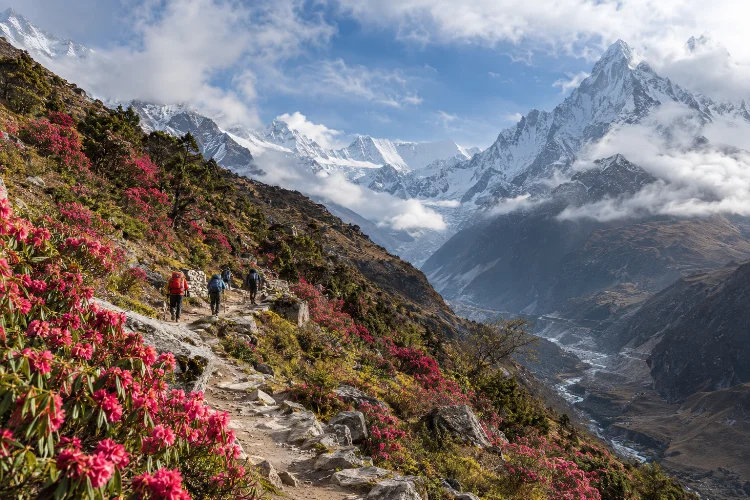
Nepal’s tourism authority identifies spring and autumn as the country’s strongest general trekking seasons. Spring brings warmer temperatures and flowering rhododendrons, although conditions can still become snowy or stormy at higher elevations.
This is a good season for routes that climb gradually through forested elevations before entering alpine terrain.
Instead of immediately targeting the highest possible pass, consider routes where vegetation changes become part of the journey. Lower Himalayan forests can be particularly attractive during this period, while longer daylight makes multi-hour trekking days more manageable.
Bhutan also becomes appealing in spring. Its official tourism platform describes March to May as spring, with relatively dry early conditions and landscapes coming into bloom. Several established Bhutanese treks are specifically recommended during spring months.
The main strategy is keeping some weather flexibility. Spring can deliver excellent conditions, but high passes should never be treated as guaranteed.
Autumn Is the Safest Default for Classic High Routes
If you want one broadly reliable Himalayan trekking window, autumn is difficult to beat.
In Nepal, the clearest skies commonly arrive after the summer monsoon, especially around October and November. Nepal Tourism Board specifically highlights post-monsoon autumn for visibility and trekking conditions.
That makes autumn ideal for routes where mountain views are a major reason for going.
Everest, Annapurna, Manaslu, and similar high-altitude areas benefit from clearer air, while trails and river crossings are generally more predictable after the heaviest seasonal rain has passed.
Bhutan experiences a similar shift. Late September through November brings brighter days after the rainy season, although early snowfall can occur at high elevations.
The disadvantage is popularity.
Classic trails become busier, so trekkers looking for quieter experiences can choose alternative valleys or start slightly later in the season. Just remember that temperatures fall quickly as November progresses.
Monsoon Trekking Requires Changing Regions, Not Cancelling the Trip
June through September sounds like a terrible period for Himalayan trekking if you only consider the wetter southern slopes.
Nepal receives around 80% of its annual precipitation during the June–September monsoon. Yet the mountains themselves create rain-shadow regions where conditions are dramatically drier.
Mustang receives less than 300 mm of annual rainfall according to Nepal Tourism Board, compared with far wetter areas such as Pokhara.
That changes the entire planning strategy.
Instead of trying to trek a conventional monsoon-soaked route, move behind the main Himalayan barrier. Nepal Tourism Board specifically identifies Mustang, Manang, Dolpo, and parts of the far west as rain-shadow alternatives for monsoon trekking.
Ladakh offers another option.
Much of the region has a high-altitude desert climate, and summer provides relatively practical access.
India’s official tourism information places the useful travel window for many Ladakh locations between roughly May and September, while the Markha Valley trek is commonly suited to June through September.
So monsoon planning is really about geographic repositioning.
Winter Routes Should Stay Lower and More Flexible
Winter creates extraordinary Himalayan scenery, but high passes can become a completely different proposition.
Snow closes or complicates routes, daylight becomes shorter, and temperatures fall sharply after sunset. Nepal Tourism Board notes that trekking remains possible during winter, with clear skies often compensating for the colder conditions.
The trick is lowering your ambitions vertically.
Instead of designing an itinerary around a 5,000-metre pass, choose foothill routes, lower cultural treks, or journeys with easy retreat options.
Bhutan demonstrates this nicely. Its official trekking catalogue includes routes such as the Punakha Winter Trek and Samtengang Winter Trek, while northern high elevations experience much harsher conditions and frequent snowfall above around 3,000 metres.
Winter can also be excellent for travelers who value solitude.
Accommodation may be more limited, though, so confirm whether lodges and transport services remain operational rather than assuming everything functions exactly as it does in October.
India’s Himalayas Need Region-Specific Timing
Northern India shows why one Himalayan calendar does not work everywhere.
Himachal Pradesh receives significant monsoon rainfall during summer.
Incredible India’s information for destinations such as McLeodganj warns that July and August can bring heavy rain that makes trekking more difficult, while Bhrigu Lake is better suited to April–June and September–October.
Some mountain roads are also highly seasonal.
Rohtang Pass, connecting toward Lahaul-Spiti, is generally motorable only for a limited part of the year, with official tourism information describing roughly June through October as the usual access period.
Move farther north toward Ladakh and the pattern changes because the landscape lies in a much drier climatic zone.
This is why planning “an India Himalaya trek in August” is too vague.
First decide whether you mean rainy Himachal slopes, Sikkim, high-desert Ladakh, or another mountain region. Then build the route around that specific climate.
Altitude Strategy Should Change With the Season Too
Weather may determine whether a trail is accessible, but altitude determines how quickly you should move.
The CDC recommends avoiding rapid ascent to high sleeping elevations whenever possible. Above 3,000 metres, increases in sleeping altitude should generally remain around 500 metres per night, with an additional acclimatization day for every 1,000 metres gained.
Season can complicate that schedule.
In cold weather, trekkers may be tempted to rush through uncomfortable high camps. During monsoon conditions, they may speed up to beat an incoming storm. Neither is a good reason to ignore acclimatization.
Design the route around where you sleep, not just how far you walk.
A 16-kilometre day that ends 250 metres higher can make more sense than an eight-kilometre stage that gains 800 metres in sleeping elevation.
Fitness does not eliminate altitude risk, so even experienced hikers should keep the ascent profile realistic.
Build Buffer Days Around Passes and Transport
A seasonal itinerary becomes much stronger when it includes time that is intentionally unplanned.
High passes can become temporarily difficult after snowfall. Rain can slow road transfers, and mountain flights can be delayed by visibility.
This is especially important when a trek finishes in a remote valley.
Do not calculate the final walking day, road transfer, domestic flight, and international departure as though every stage will operate perfectly.
Add at least one flexibile day before an important connection, and more for particularly remote routes.
The same principle applies in the middle of a trek.
If your route depends on one exposed high pass, build an alternative day around it. That spare time allows you to wait for better conditions rather than crossing simply because the spreadsheet says Tuesday is “pass day.”
Mountain weather does not read your itinerary.
Match the Route Length to Available Daylight
Season affects not only weather but how much usable daylight you have.
Long summer days allow earlier starts and more generous walking windows. Winter gives considerably less margin for slow progress, navigation problems, or unexpected stops.
This should influence daily distance.
A 20-kilometre section might be completely reasonable during a stable spring day but uncomfortable in late autumn when temperatures fall quickly in the afternoon.
Start earlier when conditions are most stable and avoid designing every stage around arriving near sunset.
Also consider trail surfaces.
Wet monsoon paths, snow, ice, and muddy forest sections can reduce your normal walking speed significantly. Maps show distance; they rarely show how tiring the enviroment will be that week.
Choose Accommodation and Gear for the Actual Season
A route with permanent teahouses requires different preparation from one involving seasonal camps.
Before departure, confirm whether accomodation remains open during shoulder or winter periods. Mountain businesses can operate seasonally, especially in quieter valleys.
Gear should follow the same logic.
Spring requires layers for warm lower valleys and cold high camps. Monsoon treks need serious rain protection and dry storage. Autumn often combines pleasant daytime walking with freezing nights at altitude.
Winter requires a much greater margin for cold.
Avoid packing from a generic “Himalaya trekking list.” A March trek in Bhutan, an August trek through Mustang, and a November route in Nepal may cross similar elevations but require very different equipment.
Treat Seasonal Planning as a Route Filter
The easiest way to create a Himalayan itinerary is to reverse the usual planning process.
Do not choose a trail first and then ask whether your travel month works.
Start with the month.
For spring, prioritize Nepal’s forest-and-alpine routes, Bhutan, and selected Indian Himalayan regions. In monsoon months, consider the rain shadows of Mustang, Manang, Dolpo, or Ladakh.
Autumn opens the widest selection of classic high routes, while winter is better for lower, culturally focused journeys.
That method removes many bad options immediately.
It also makes alternative routes feel intentional rather than like compromises.
Sometimes the lesser-known seasonal choice becomes far more memorable than following the famous trek at the wrong time.
Designing seasonal trekking routes across the Asian Himalayas means accepting that the mountains change faster than travel wish lists do.
Spring brings flowers, longer days, and improving temperatures. Autumn generally offers the clearest skies and broadest selection of high routes.
Monsoon months reward travelers who move into rain-shadow regions, while winter favors lower trails and conservative itineraries.
Whatever the season, altitude, weather, daylight, transport access, and sleeping elevation should shape the schedule before daily distance does.
Instead of asking which Himalayan trek is “best,” start with when you can travel. Then choose the mountain region that works with that season rather than fighting against it.
That approach creates safer routes, better scenery, and considerably more enjoyable days on the trail.