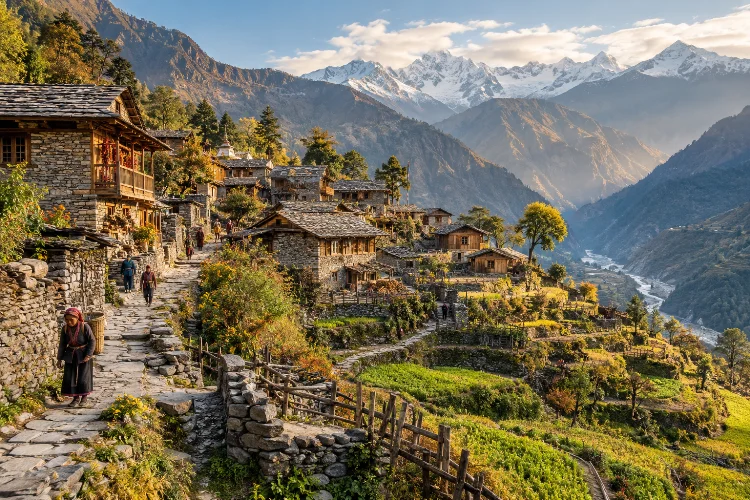
Some of Asia’s most memorable destinations are not cities, famous temples, or heavily photographed viewpoints. They are small settlements hidden behind mountain passes, surrounded by terraced fields, high deserts, forests, or snow-covered peaks.
Reaching them usually takes more effort. Roads become narrower, public transport becomes less frequent, and a destination that looks close on a map may require an entire day of travel. Yet that difficulty is often exactly what preserves their distinctive character.
Exploring remote mountain villages across Asia’s highland regions offers a different way to understand the continent.
Highland settlements reveal how people adapt architecture to climate, create agriculture on steep terrain, maintain local languages, and build communities far from major economic centres.
From the walled settlement of Lo Manthang in Nepal to Laya in Bhutan and traditional villages of Japan’s mountainous Chubu region, each place has developed according to its own geography.
The best visits are slow, respectful, and curious. These are living communities, not simply scenic backdrops.
Lo Manthang Reveals the High-Desert Culture of Upper Mustang
Upper Mustang feels very different from the greener Himalayan landscapes commonly associated with Nepal.
The region sits in the Himalayan rain shadow and forms part of the broader Tibetan Plateau environment. Its old capital, Lo Manthang, is a historic walled settlement surrounded by dry valleys, cliffs, monasteries, agricultural plots, and high mountains.
Nepal Tourism Board notes that Upper Mustang had little contact with much of the outside world for centuries and remained a separate kingdom within Nepal until the mid-20th century. Foreign trekking access opened only in the 1990s, and special permit requirements still apply.
That history helps explain why the area retains such a distinct cultural identity.
The landscape also shapes settlement patterns. Fertile ground is limited, so villages tend to cluster around places where irrigation makes farming possible.
Lo Manthang deserves more than a quick overnight stay. Walking its narrow lanes, visiting monasteries, and exploring neighbouring valleys reveals far more than simply reaching the settlement and immediately turning around.
Turtuk Shows How Culture Can Change Within One Mountain Valley
Ladakh’s Nubra Valley provides one of the clearest examples of how dramatically culture can shift over a relatively short distance.
Around Diskit and Hunder, Buddhist monasteries and Ladakhi traditions dominate the landscape. Continue toward Turtuk, however, and the architecture, language, food, and religious traditions begin changing.
India’s official tourism platform describes Turtuk as one of several Balti villages in this part of the Nubra region.
The settlement remained isolated from mainstream tourism for decades, and its orchards, barley fields, stone houses, and Balti culture give it a very different character from better-known parts of Ladakh.
The journey is part of the experience.
Roads follow the Shyok River through enormous rocky valleys where villages appear as narrow green patches against barren mountains.
Instead of rushing back to Leh on the same day, an overnight stay makes more sense. Small guesthouses allow travelers to experience evenings and mornings after day visitors have gone.
Turtuk demonstrates why highland travel becomes more interesting when you stop thinking of mountain regions as culturally uniform.
Laya Preserves Bhutan’s Highland Way of Life
Few settlements make their altitude as obvious as Laya.
Located in northern Bhutan’s Gasa district at roughly 4,000 metres, the village sits within an environment shaped by high peaks, alpine vegetation, glacial rivers, and pastoral traditions.
Bhutan’s Royal Highland Festival was created partly to celebrate and preserve the culture and economy of the country’s highland communities.
Laya’s residents, known as Layaps, maintain distinctive clothing, food traditions, songs, animal husbandry, and relationships with the surrounding mountains.
Getting there still requires commitment.
Official festival information describes a long journey from Thimphu followed by a multi-hour hike after the motorable road ends. That effort immediately changes the pace of the visit.
Travelers should also remember that 4,000 metres is serious altitude.
The CDC advises gradual ascent to high elevations and recommends allowing time for acclimatization rather than moving rapidly from low altitude to high sleeping elevations.
In a place like Laya, a slow itinerary is not merely more enjoyable. It is more sensible.
Shirakawa-go Shows How Architecture Adapts to Heavy Snow
Not every remote mountain village lies in the Himalayas.
Central Japan’s Shirakawa-go and Gokayama demonstrate an entirely different response to mountain geography.
The historic villages of Ogimachi, Ainokura, and Suganuma developed within steep valleys of the Chubu mountain region.
UNESCO notes that these settlements were geographically isolated for long periods and developed distinctive gassho-style farmhouses with steeply pitched thatched roofs.
Those roofs were not designed simply to look beautiful.
Their sharp angle helps cope with heavy snowfall, while the large internal structures historically supported economic activities including silkworm cultivation.
This makes the villages excellent examples of vernacular architecture responding directly to climate and livelihood.
Shirakawa-go itself is now well known, so travelers seeking a quieter experience can consider neighbouring Ainokura or Suganuma as part of a wider regional journey.
The lesson remains the same: mountain architecture usually makes far more sense once you understand the enviroment that created it.
Batad Turns Steep Mountains Into Productive Farmland
In the Philippine Cordilleras, villages are shaped less by snow or high desert and more by extraordinary agricultural engineering.
The Ifugao Rice Terraces demonstrate how generations of farmers adapted steep mountain slopes for cultivation. UNESCO recognizes five major terrace clusters, including Batad, Bangaan, Mayoyao, Hungduan, and Nagacadan.
Batad is perhaps the most visually dramatic.
Terraces form an amphitheatre around the village, creating a landscape where agriculture, settlement, irrigation, and mountain terrain are almost impossible to seperate.
But describing the terraces as an ancient engineering wonder only tells part of the story.
They remain a living cultural landscape. Fields require constant maintenance, water systems depend on environmental knowledge, and agricultural traditions are tied closely to community life.
Visitors should therefore treat paths through the terraces as working landscapes rather than unrestricted hiking parks.
Hiring a local guide can add enormous context while also keeping tourism income within the community.
Mountain Villages Explain Why Architecture Looks Different
One of the most interesting parts of highland travel is noticing how houses change from region to region.
In the snowy mountains of Japan, steep roofs deal with heavy accumulation. In the dry Himalayan regions of Nepal and Ladakh, flat-roofed stone or mud structures fit a very different climate.
Building materials usually come from what is available nearby.
Stone, timber, earth, bamboo, and thatch are not simply stylistic decisions. They reflect transportation limitations, weather patterns, local skills, and the need to repair buildings using accessible materials.
Village layout matters too.
Compact settlements may reduce exposure to harsh weather or conserve valuable agricultural land. Houses built on slopes can follow contour lines, while religious buildings may occupy elevated positions overlooking farmland.
Instead of photographing a beautiful house and moving on, ask why it was built that way.
Architecture becomes much more interesting when treated as a record of adaptation.
Agriculture Reveals How Communities Survive at Elevation
Mountain landscapes rarely offer unlimited farmland.
That forces communities to become inventive.
Upper Mustang relies heavily on irrigated pockets of productive land within an otherwise dry landscape. Ladakhi villages often appear as bright green areas surrounded by barren rock.
The Philippine Cordilleras use terracing to transform steep mountains into agricultural systems, while traditional Japanese mountain communities historically combined farming with activities such as sericulture.
Food culture reflects these conditions.
Barley, potatoes, buckwheat, rice, dairy products, preserved foods, and hardy vegetables may become more important depending on climate and altitude.
Eating locally therefore tells you something about geography.
Instead of searching for the same international menu in every destination, try dishes produced from what actually grows or is raised nearby.
That is often one of the simplest ways to understand mountain life.
Remote Does Not Mean Untouched
It is tempting to describe isolated settlements as places “where time stood still.”
That idea is usually inaccurate.
Mountain communities use smartphones, send children to urban schools, improve roads, open guesthouses, migrate for employment, and respond to tourism just like communities elsewhere.
Better transportation can bring healthcare, education, markets, and economic opportunities. It can also increase construction pressure, waste, cultural commercialization, and seasonal crowding.
Travelers contribute to those changes.
Choosing locally owned accomodation, guides, cafés, and transport operators can help keep more tourism income inside the community.
Responsible travel also means avoiding the assumption that residents exist to be photographed.
Ask permission before taking close portraits, especially inside homes, during ceremonies, or around religious activities.
A remote village is still someone’s neigbourhood.
Plan Transportation More Conservatively Than the Map Suggests
Mountain distance is deceptive.
A 70-kilometre journey can take several hours when roads cross passes, follow river gorges, or include unpaved sections.
Weather can complicate things further.
Rain may trigger landslides, winter conditions can close roads, and snow can make high passes inaccessible. In more isolated areas, one cancelled bus or delayed vehicle may change the entire day’s schedule.
Avoid placing a remote village immediately before an international flight.
Whenever possible, return to a better-connected town or city at least one day before an important departure.
Research the final section of tranportation carefully as well. Some villages remain reachable only by hiking, shared vehicles, or limited seasonal transport.
The journey may look inefficient, but that isolation is often part of what makes the destination distinctive.
Stay Longer Instead of Collecting Villages
Remote mountain travel becomes exhausting when every night is spent somewhere new.
The better strategy is usually to choose fewer settlements and stay longer.
Two or three nights provide enough time to walk beyond the central village, experience mornings and evenings, try local food, and observe ordinary routines.
It also reduces the temptation to treat every community as a quick photo stop.
Lo Manthang, Turtuk, Laya, Batad, and the villages of Gokayama are interesting for very different reasons. Trying to squeeze all the highlights into a few hours removes much of what makes them special.
Highland travel rewards patience.
The quieter the destination, the less useful a rushed itinerary becomes.
Exploring remote mountain villages across Asia’s highland regions reveals how strongly geography can shape everyday life.
Lo Manthang reflects the high-desert culture of Upper Mustang, Turtuk introduces travelers to Balti traditions in Ladakh, and Laya preserves Bhutan’s distinctive highland culture.
Japan’s mountain villages demonstrate architectural adaptation to deep snow, while Batad shows how Ifugao communities transformed steep terrain into a living agricultural landscape.
What connects these destinations is not simply isolation. It is adaptation.
Travel slowly, use local services, respect homes and traditions, and build enough flexibility into the journey for mountain conditions.
Instead of treating remote villages as hidden attractions to collect, choose one region and stay long enough to understand why people built a life there in the first place.