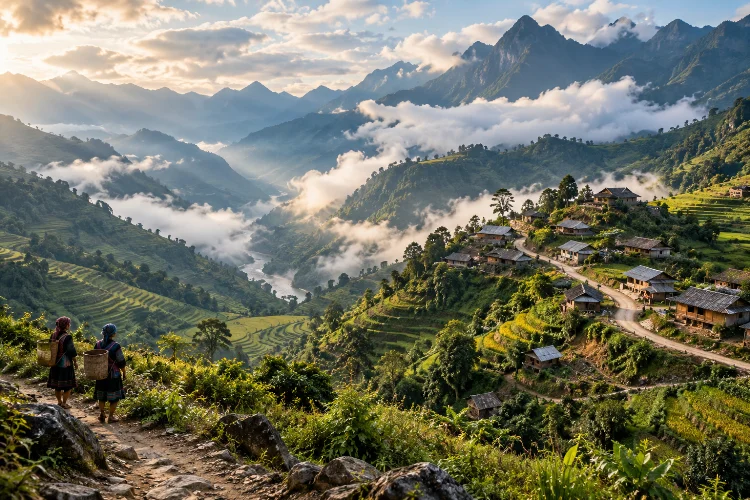
Southeast Asia is usually pictured through tropical beaches, crowded capitals, and humid lowland landscapes. Travel into the mountains, however, and the region can feel completely different.
Temperatures drop, roads become slower, clouds drift through valleys, and farming adapts to steep slopes. Villages may preserve languages, architecture, agricultural systems, and seasonal traditions that developed far from major urban centres.
That is what makes discovering remote highland regions across Southeast Asia so rewarding.
Northern Vietnam’s limestone plateaus, the mountains of northern Thailand and Laos, the Cordilleras of the Philippines, and Sulawesi’s Toraja highlands all reveal landscapes shaped by the relationship between geography and culture.
These destinations require more patience than a typical city break. Journeys may involve winding roads, limited public transportation, sudden weather changes, and fewer tourism services.
But that slower pace is part of the experience. Highland travel encourages visitors to pay attention not only to dramatic scenery, but also to how communities have adapted to difficult terrain over generations.
Ha Giang Reveals Northern Vietnam at Its Most Dramatic
Few Southeast Asian highland journeys feel as visually dramatic as Ha Giang.
Located in Vietnam’s far north, the region is characterized by limestone mountains, narrow valleys, remote settlements, and winding roads that climb through spectacular passes.
Vietnam’s official tourism authority describes Ha Giang as a frontier area around 300 kilometres from Hanoi, with public transportation within the mountainous region remaining relatively limited.
The famous Ha Giang Loop connects locations such as Quan Ba, Dong Van, Meo Vac, and Ma Pi Leng Pass.
Yet the scenery is only part of its appeal. Numerous ethnic communities live throughout the region, meaning architecture, clothing, markets, food, and agricultural practices can change noticeably between valleys.
Traveling here works best when the route is treated as a multi-day journey rather than a race.
Experienced riders may travel independently by motorcycle, while visitors uncomfortable with mountain roads can use guided motorcycle or private-car options. Heavy monsoon weather can also affect conditions, so flexibility matters.
Mae Hong Son Offers a Slower Side of Northern Thailand
Chiang Mai receives most of northern Thailand’s attention, but continue west and the landscape becomes increasingly mountainous.
Mae Hong Son sits in a valley surrounded by high ranges and is sometimes called the “city of three mists.” Thailand’s tourism authority highlights its mountains, forests, hot springs, temples, trekking opportunities, and diverse local communities.
The journey itself explains why the region historically felt isolated.
Roads twist continuously through the hills, and travelers susceptible to motion sickness are even advised by the Tourism Authority of Thailand to prepare for the bends.
Rather than rushing directly between Mae Hong Son and Pai, allow time for smaller stops.
Mountain viewpoints, villages, lakes, temples influenced by neighbouring Myanmar, and forest landscapes make the wider province more interesting than either town alone.
The result is a Thailand itinerary with a completely different rhythm from Bangkok or the southern islands.
Luang Namtha Connects Mountains, Forests, and Village Life
Northern Laos offers some of mainland Southeast Asia’s most rewarding trekking landscapes.
Luang Namtha Province sits near the borders with China and Myanmar and is largely mountainous. Official Laos tourism information highlights trekking, cycling, village visits, and activities within the Nam Ha National Protected Area.
For travelers, Luang Namtha town functions as a practical base.
From there, guided routes can extend into forested areas and rural communities where agriculture and village life remain closely connected with the surrounding landscape.
This is also a place where responsible travel matters.
Remote communities should not be treated like attractions created for photography. Using locally operated guides, respecting permission before photographing people, and spending money on community-based services can make tourism more useful to residents.
The highlands become much more meaningful when visitors understand that the landscape is somebody’s home, workplace, and cultural enviroment—not simply a trekking backdrop.
The Philippine Cordilleras Are Living Agricultural Landscapes
Northern Luzon demonstrates how people can transform extremely steep terrain without erasing its natural character.
The Rice Terraces of the Philippine Cordilleras include several remarkable Ifugao terrace systems.
UNESCO describes them as a living cultural landscape shaped over roughly two millennia through communal farming knowledge, water management, forest protection, and agricultural traditions.
Batad is particularly memorable.
Its terraces rise in an amphitheatre-like formation around a settlement, while Bangaan, Mayoyao, Hungduan, and Nagacadan reveal different patterns of mountain agriculture.
The engineering is impressive, but focusing only on the view misses the larger story.
The terraces rely on community cooperation and water drawn from forested mountain areas. UNESCO also notes that migration, environmental change, and shifts in agricultural labour create ongoing conservation challenges.
Travelers should therefore remember that these are functioning farms, not abandoned monuments.
Walking slowly, hiring local guides, staying locally, and respecting active fields can help preserve the connection between tourism and the communities maintaining the landscape.
Tana Toraja Combines Highland Scenery With Deep Cultural Traditions
On Sulawesi, the Toraja highlands provide one of Indonesia’s most distinctive mountain journeys.
Tana Toraja lies among mountains, valleys, rivers, rice fields, and traditional settlements. Indonesia’s tourism authority highlights the region’s tongkonan houses, rock-cut burial sites, agricultural landscape, and elaborate ceremonial traditions.
Rantepao is commonly used as a base for exploring the wider region.
From there, travelers can move through villages, farmland, coffee-growing areas, traditional architectural sites, and burial landscapes. The distances are not always enormous, but winding roads and frequent stops make slow exploration more satisfying.
Toraja also requires cultural sensitivity.
Funeral ceremonies can be major community events with complex religious and social meanings. Visitors should follow local guidance rather than assuming every ceremony is automatically open for casual observation.
Getting there reinforces the sense of remoteness. Overland travel from Makassar remains an important access route, and the journey can take many hours through changing Sulawesi landscapes.
Cameron Highlands Offers a More Accessible Highland Experience
Not every Southeast Asian highland region requires expedition-style travel.
Malaysia’s Cameron Highlands provides a more accessible introduction to mountain landscapes, with road and bus connections from major urban centres.
The region includes Tanah Rata, Brinchang, and Ringlet, surrounded by tea plantations, farms, forest trails, and cooler mountain scenery. Tourism Malaysia notes that Cameron Highlands is Malaysia’s largest highland resort and highlights its tea-growing landscapes and jungle trails.
Its history also gives it a different character.
The highlands developed partly as a colonial-era hill station, leaving Tudor-inspired buildings and garden traditions alongside modern agriculture.
Higher areas around Mount Brinchang contain misty montane forest ecosystems, including the well-known Mossy Forest.
Cameron Highlands is no longer truly isolated, but it works well as a transition destination for travelers who want highland scenery without complicated logistics.
It also shows how tourism can change mountain regions quickly, making responsible development increasingly important.
Highland Travel Requires Different Planning
Mountain journeys operate differently from lowland city trips.
A route that appears short on a map can take hours because of switchbacks, road conditions, elevation changes, or weather. Landslides and heavy rain can occasionally disrupt transportation during wetter periods.
Avoid building a schedule around exact arrival times.
If possible, leave buffer time between a remote mountain section and an international flight. Choose accomodation that can help confirm local transport conditions, and carry some cash because digital payment or ATM access may be inconsistent in smaller settlements.
Clothing also deserves attention.
Even in tropical Southeast Asia, evenings at elevation can feel surprisingly cool. Rain layers, comfortable walking shoes, and lightweight warm clothing can become more useful than another beach outfit.
Cultural Respect Matters More in Remote Communities
Highland tourism often brings visitors into communities with strong local customs.
That creates opportunities for meaningful cultural exchange, but it also creates risks.
Avoid photographing ceremonies, homes, or people without permission. Do not assume traditional clothing exists for tourist entertainment, and be careful with tours that turn ethnic communities into staged spectacles.
Community-based guides can provide context that independent sightseeing often misses.
They can explain agricultural practices, local beliefs, architecture, food, and landscape management while helping visitors distinguish between public areas and spaces that should remain private.
Spending money locally also matters.
A family-run homestay, locally owned restaurant, village guide, or small transport operator may keep considerably more tourism income within the region than a package controlled from a distant city.
Slow Travel Works Better in the Mountains
Trying to cover three mountain provinces in four days usually means experiencing mostly roads.
Choose fewer bases instead.
Three or four nights can allow time for hiking, weather delays, village visits, markets, and unplanned conversations without turning every morning into another departure.
This is especially useful in places such as Ha Giang or Toraja, where the journey between destinations is part of the experience.
Stop at viewpoints. Walk through agricultural landscapes. Notice how roofing styles, crops, vegetation, and settlement patterns change with altitude.
Remote highlands reward curiosity far more than speed.
Discovering remote highland regions across Southeast Asia reveals a side of the region that beaches and megacities cannot provide.
Ha Giang offers dramatic limestone roads, Mae Hong Son combines misty mountains with northern Thai traditions, while Luang Namtha opens routes into the forests and communities of northern Laos.
The Philippine Cordilleras demonstrate generations of sophisticated mountain agriculture, Toraja connects extraordinary landscapes with living cultural traditions, and Cameron Highlands provides a more accessible introduction to Southeast Asian mountain travel.
These regions are best experienced slowly. Build flexible itineraries, respect local communities, and accept that mountain roads rarely care about your schedule.
Instead of asking how many places you can fit into one trip, choose one highland region and give it enough time to reveal what makes it different.