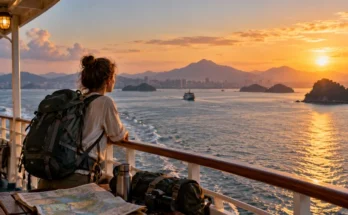
Flying between Asian capitals is easy. Crossing several countries by train, bus, shared van, or riverboat is a completely different kind of trip.
Overland travel lets you watch landscapes and cultures change gradually. Thai highways turn into Lao mountain roads, Vietnamese cities emerge after rural border zones, and languages, currencies, food, and architecture shift without the abrupt reset of an airport.
But planning overland routes through multiple Asian border crossings requires more preparation than connecting flights. A border that looks obvious on a map may not accept your visa type.
Buses may stop on either side rather than cross directly, immigration opening arrangements can change, and one slow checkpoint can affect every booking that follows.
Regional connectivity continues to improve, particularly in Southeast Asia, where ASEAN’s 2026-2030 transport plan prioritizes a more seamless and efficient transport network.
Still, travelers need flexibility. The best overland itinerary is not the one with the most borders. It is the one where every crossing fits logically into the route.
Start With the Border Crossings, Not Just the Countries
Most people plan an Asia trip by writing down countries first.
Thailand. Laos. Vietnam. Cambodia.
A better approach is to identify the actual checkpoints connecting them before deciding which cities belong in the itinerary.
This matters because international borders are not uniformly open to every traveler, visa type, or transportation method.
Vietnam’s official e-Visa system, for example, maintains a specific list of approved land border gates where electronic visas can be used. These include major crossings such as Huu Nghi, Lao Bao, Moc Bai, Ha Tien, Lao Cai, Tay Trang, and others
So instead of saying, “I’ll travel from Laos into Vietnam,” plan the exact corridor.
Which Lao town leads naturally toward an approved Vietnamese checkpoint? What transportation operates on both sides? Does your chosen visa work there?
Those questions should come before hotel bookings.
Build a Geographic Flow That Avoids Backtracking
Overland travel becomes inefficient very quickly when the route zigzags.
Imagine traveling Bangkok → Siem Reap → Vientiane → Ho Chi Minh City → northern Vietnam. It is possible, but geography is working against you.
A cleaner mainland route might travel through northern Thailand into Laos, continue toward Vietnam, then gradually move south before entering Cambodia.
Another could connect Bangkok with Cambodia, follow the country east toward Vietnam, then move north through Vietnam.
There is no universal perfect route.
The important principle is progression.
ASEAN’s current transport strategy emphasizes stronger regional connectivity and easier movement between member states, but transport infrastructure still works best along particular corridors rather than every possible country combination.
Open a map and draw one continuous line. If that line repeatedly crosses itself, simplify the intinerary.
Check Whether Your Visa Matches the Checkpoint
Having permission to enter a country does not necessarily mean you can enter through every border.
This is especially important with electronic visas.
Laos currently accepts its official eVisa only at designated ports, including Lao–Thai Friendship Bridges I, II, and IV, the Boten International Checkpoint, Boten Railway Station, and several airports and railway facilities.
The official Lao eVisa FAQ specifically warns that travelers using an undesignated port cannot simply assume the eVisa will work there
Cambodia provides another useful reminder that conditions can change.
Its official eVisa portal currently lists Bavet and Tropaeng Kreal among land checkpoints accepting eVisa, while some other checkpoints are shown as temporarily unavailable for eVisa entry.
Never rely entirely on an old travel blog.
Use official immigration or eVisa websites shortly before departure, then recheck the exact border rather than just the country’s general visa policy.
Treat Every Border Day as a Real Travel Day
A five-hour bus trip does not necessarily mean you have half the day available for sightseeing.
International road journeys involve additional uncertainty.
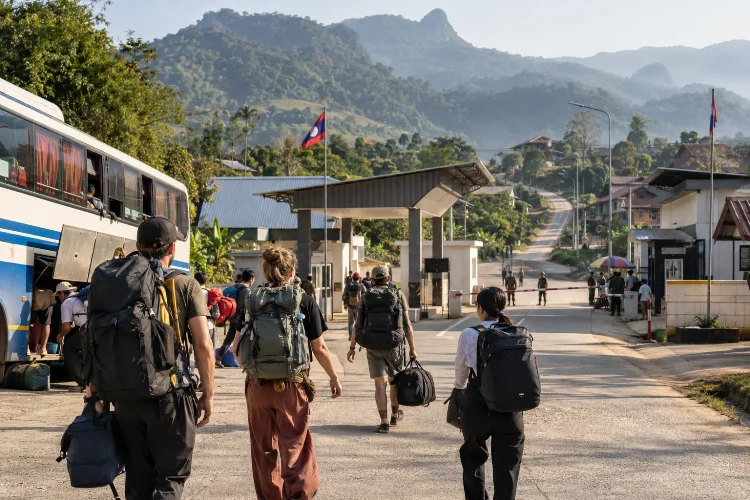
You may need to leave the bus, carry luggage through departure immigration, walk or take a shuttle through the border zone, complete arrival procedures, exchange money, buy a local SIM, and sometimes board another vehicle.
That process can be fast.
It can also take hours.
Avoid booking an expensive tour immediately after an international land crossing. Similarly, do not assume a scheduled 2 p.m. arrival means you will be comfortably walking around your hotel neighbourhood by 2:30.
Treat border days as low-productivity days.
Arrive, find accomodation, get cash, eat, and start serious sightseeing the next morning.
This approach makes delays considerably less stressful.
Understand the Difference Between Through Buses and Transport Handoffs
A ticket advertised as “Bangkok to Vientiane” or “Phnom Penh to Ho Chi Minh City” can hide very different travel arrangements.
Some international buses physically cross the border.
Other services take you to immigration, wait while passengers complete formalities, then continue afterward. In less integrated corridors, your first vehicle may stop completely and require you to arrange another bus, taxi, or shared van on the opposite side.
Know which type you are booking.
This becomes particularly important when traveling with heavy luggage.
A seamless international coach is very different from unloading a large suitcase, walking through immigration in tropical heat, finding local currency, and negotiating a second vehicle.
Ask transport operators specifically whether the same bus continues after immigration.
If not, research the onward station before arriving.
Small logistical details make overland travel dramatically easier.
Build Buffer Nights Before Important Connections
One delayed border should not destroy the rest of your trip.
Suppose you cross from Cambodia into Vietnam on Tuesday and have an international flight from Ho Chi Minh City Tuesday evening.
That is unnecessarily risky.
Schedule the border crossing at least a day earlier when an expensive flight, fixed train, or other important commitment depends on it.
The same rule applies to multiple consecutive crossings.
If your route involves Thailand → Laos → Vietnam over a short period, do not make every hotel non-refundable and every bus departure perfectly interconnected.
Leave space.
International travel-document requirements can change, and IATA recommends checking passport, visa, and health conditions close to travel because regulations are continuously updated. Its Travel Centre draws on Timatic data used widely by airlines.
Flexibility is not poor planning.
It is part of good planning.
Complete Digital Arrival Requirements Before Reaching the Border
Immigration is becoming more digital across Asia, which can make entry smoother – but only if travelers know what is required.
Thailand’s Digital Arrival Card, for example, applies to non-Thai nationals entering by land, air, or sea. The official Immigration Bureau guidance says travelers must submit it online before arrival, within the specified pre-arrival window.
Cambodia also requires travelers to complete its e-Arrival process, according to the official government eVisa portal.
Do these tasks while you still have reliable internet.
Trying to complete an online form beside a remote border post with weak mobile reception is an avoidable problem.
Save confirmation screenshots or PDFs offline where permitted, and keep digital copies of your passport, visa approval, hotel details, and onward tickets.
Paper copies can also be useful in regions where digital systems are inconsistent.
Carry Small Amounts of Useful Currency
Border areas are not always good places to solve financial problems.
ATMs may exist, but they can be out of service, reject foreign cards, or be located several kilometres after immigration. Currency exchange rates at border zones can also be less favorable than in larger cities.
Carry enough cash for immediate transport, food, and small border-related expenses.
Do not carry unnecessarily large amounts.
The objective is simply to avoid becoming stuck because the first taxi, shared van, or bus after immigration accepts only local currency.
Small-denomination notes are especially useful.
Once you reach the next substantial town, withdraw or exchange additional money under calmer conditions.
This is also a good reason to know the name and approximate cost of your onward tranport before crossing.
Keep Your Route Flexible When Border Conditions Change
Land borders are more vulnerable to operational changes than major international airports.
Opening arrangements, transportation services, visa acceptance, or security conditions can change.
Cambodia’s official eVisa portal currently demonstrates this directly by listing some land checkpoints as temporarily closed for eVisa entry while others remain available.
That is why every complex overland itinerary should have at least one alternative.
If Crossing A becomes impractical, can you use Crossing B without rebuilding the entire trip?
Could you take a train instead?
Would a short flight save three complicated days?
Overland travel should not become an ideological commitment.
Sometimes flying one segment makes the rest of an otherwise excellent ground route work far better.
Do Not Schedule Too Many Borders in One Week
Crossing borders is interesting.
Doing it every second day becomes exhausting.
Each new country means different money, mobile connectivity, transportation systems, languages, entry procedures, and social expectations.
Give yourself time to settle.
A four-week journey through Thailand, Laos, Vietnam, and Cambodia does not need seven border crossings. One logical entry into each country is usually enough.
Spend longer inside regions instead.
Follow the Mekong for several days. Stay in Luang Prabang. Explore northern Vietnam rather than immediately racing south. Give Cambodia time beyond the first city.
Overland travel is at its best when the border connects two experiences rather than becoming the experience itself.
Use Major Crossings When Reliability Matters Most
Remote crossings can sound adventurous, but they often come with fewer transport options and less room for mistakes.
Major international checkpoints generally make more sense for travelers on their first complex overland journey.
Vietnam’s official eVisa system, for instance, lists numerous approved international land gates, allowing travelers to design different corridors while still confirming that their intended checkpoint supports electronic entry.
Laos similarly identifies specific Friendship Bridges and railway checkpoints compatible with its eVisa system.
Established crossings also tend to have more onward buses, taxis, accommodation, and other traveler infrastructure.
Once you understand how regional border travel works, smaller crossings become easier to evaluate.
Adventure is useful.
Unnecessary uncertainty is not.
Planning overland routes through multiple Asian border crossings works best when borders are treated as part of the itinerary rather than invisible lines between destinations.
Choose exact checkpoints before booking the surrounding route, confirm that your visa is accepted there, and understand whether transportation continues across the border or requires a handoff.
Add buffer time, prepare digital arrival forms in advance, and avoid placing critical flights immediately after international road journeys.
Most importantly, keep the route geographically simple.
Regional transport networks are improving, but regulations and checkpoint conditions can still change. Before departure, verify each crossing again using official immigration sources.
Build your itinerary one border at a time, and the journey between countries can become one of the most rewarding parts of traveling across Asia.